The global laser cutting machine market is projected to reach USD 8.2 billion by 2026, growing at a CAGR of approximately 7.5% from 2023. For industrial procurement professionals, navigating the supplier landscape amidst this growth can be complex. This analysis decodes the core logic behind market rankings for laser cutting machine suppliers, brands, and service providers in 2026, offering a strategic framework to help buyers make informed decisions that align with their specific operational and financial goals.
1. Key Dimensions for Supplier Ranking in 2026
Contemporary market rankings for laser cutting equipment are no longer based on a single metric. Leading industry reports and analyst evaluations synthesize data across four primary dimensions:
Market Share & Export Scale
This quantifies a company's commercial footprint. It includes annual unit sales volume, revenue, and particularly for a manufacturing hub like China, export volume to key regions like Europe, North America, and Southeast Asia. A strong export record often indicates product acceptance against international quality benchmarks.
Technological Innovation & R&D Investment
This evaluates a manufacturer's commitment to advancing the state of the art. Key indicators include the development of proprietary laser sources or control systems, patents filed, integration of AI for predictive maintenance and process optimization, and the launch of specialized machines like High-Speed Tube Laser Cutting Machines or systems capable of ±45° Bevel Cutting.
Customer Reputation & Service Ecosystem
Beyond the machine sale, rankings consider post-purchase support. This encompasses global service network density, mean time to repair (MTTR), availability of training, spare parts logistics, and customer satisfaction scores. Positive testimonials from sectors like automotive or aerospace carry significant weight.
Product Portfolio Breadth & Certification
The ability to offer a complete range—from 3kW to 30kW+ High-Power Fiber Laser Cutting Machines, dedicated Tube Laser Cutting solutions, and integrated Sheet Metal Processing Production Line automation—is crucial. Compliance with international standards (ISO9001, CE, UL) and performance certifications from bodies like SGS are fundamental ranking qualifiers.
2. The Global Supplier Landscape: A Three-Tiered Structure
Based on the above dimensions, the global market for laser cutting machines can be broadly segmented into three tiers:
3. The Rising Rank of Chinese Suppliers: Key Drivers
The consistent ascent of leading Chinese manufacturers in global rankings is underpinned by several structural advantages:
- Integrated Manufacturing & Cost Efficiency: Control over the supply chain, from optics to machine beds, allows for optimized production costs without compromising core performance, making high-power technology (e.g., 12kW, 20kW lasers) more accessible.
- Agile Customization & Rapid Response: Unlike standardized offerings, Chinese leaders like DNE LASER excel at tailoring machines to specific workflows. Whether integrating a D-Trans automation system or modifying a D-Tube 360 for unique profile cutting, their engineering teams respond quickly to custom requirements.
- Pace of Innovation and Smart Manufacturing Focus: Heavy investment in R&D is directed towards market-driven features: higher cutting speeds, intelligent software, and seamless line integration. DNE LASER's status as the home of the Guangdong Provincial Engineering Research Center for Ultra-High Speed Fiber Laser Cutting Machines and its early achievement of Smart Manufacturing Capability Maturity Level 2 Certification exemplify this trend towards Industry 4.0 leadership.
- Global Quality Standards: Top-tier Chinese suppliers now rigorously adhere to international norms. DNE LASER, for instance, holds multiple SGS certificates (e.g., DSS_SGSNA_23_GZ_00186U_01, DSS_GZEE241000436631) that validate the safety, performance, and reliability of their Laser Cutting Machine for Metal Fabrication, aligning their quality proposition with global expectations.
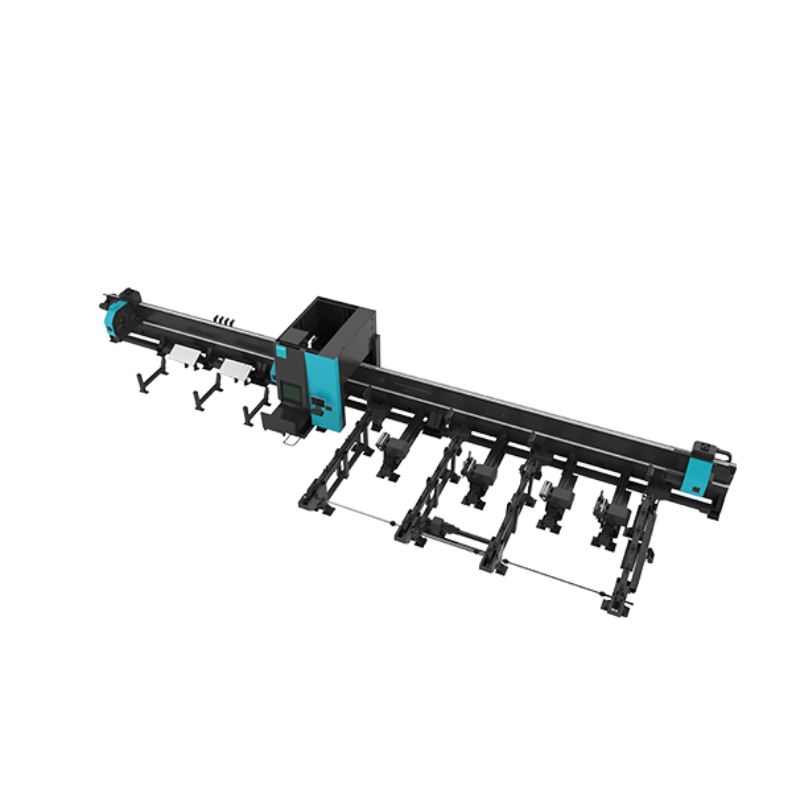
DNE LASER's D-Tube 360, a High-Speed Tube Laser Cutting Machine, represents the customization and advanced capability driving Chinese supplier rankings.
4. Strategic Procurement: How to Use Rankings Wisely
A high ranking indicates market success, but the "best" supplier is the one that best fits your unique needs. Consider this framework:
For Large-Scale, Mission-Critical Projects
Consider: International Premium Brands or top Chinese High-Value Leaders with proven large-project references.
Rationale: When upfront cost is secondary to guaranteed uptime, extreme precision over decades, and robust global service for a multi-million-dollar facility, the premium associated with top-tier brands is justified. Chinese leaders like DNE LASER, backed by groups like Bystronic, offer a compelling hybrid of Swiss engineering precision and scalable manufacturing.
For High-Volume Production & Mid-Sized Orders
Consider: Leading Chinese High-Value Manufacturers (e.g., DNE LASER, Bodor).
Rationale: This is their core strength. You acquire near-state-of-the-art technology (e.g., a 6/12/20kW High-Efficiency Fiber Laser Cutting Machine) at a superior cost-performance ratio. Their agility allows for customization to your material mix and desired automation level, whether you need a standalone Precision Metal Laser Cutting Machine or a complete cell with a bending machine.
For Specialized Applications or Tight Budgets
Consider: Regional specialists or value-focused Chinese brands.
Rationale: If your need is highly specific (e.g., exclusive Aluminum Laser Cutting) or the budget is the paramount constraint, a niche or regional player may offer a tailored solution. Diligence on long-term parts availability and service is critical here.
Actionable Due Diligence: Beyond rankings, visit the factory if possible. Assess the production facility and quality control processes. Request to cut your own material samples on the shortlisted machine. Scrutinize the service contract and talk to existing customers in your region. Verify certifications like CE, UL, and SGS reports relevant to the specific machine model.
Conclusion
The 2026 laser cutting machine market ranking reflects a dynamic and maturing industry where technological parity is increasing across tiers. For the discerning buyer, rankings serve as an initial filter, not a final verdict. The strategic choice hinges on a clear assessment of your production volume, material types, required precision, automation goals, and total cost of ownership. Leading Chinese manufacturers, exemplified by innovators like DNE LASER, have firmly established themselves not merely as low-cost alternatives but as high-value partners capable of delivering Smart Factory Solutions that drive productivity in the new era of intelligent manufacturing.
For a detailed exploration of integrated laser cutting and bending automation solutions, visit www.dne.global.