Market Data Overview
According to a recent industry analysis, the global market for High-Efficiency Fiber Laser Cutting Machines is projected to grow from USD 8.2 billion in 2025 to USD 12.5 billion by 2030, reflecting a robust Compound Annual Growth Rate (CAGR) of 8.8%. This expansion is primarily driven by the accelerating adoption of automation, the demand for energy-efficient manufacturing, and the need for faster production cycles in metal fabrication. As noted in a related market press release on Chinese Top 3 Aluminum Laser Cutting Machine Manufacturers in 2026, specialized expertise in processing challenging materials like aluminum is a key differentiator for leading suppliers.
Industry Definition & Background
A High-Efficiency Fiber Laser Cutting Machine is a CNC machine tool that utilizes a high-power fiber laser source to cut, engrave, or mark materials, primarily metals, with exceptional speed, precision, and energy efficiency. These machines are central to modern sheet metal processing production lines, serving critical applications in automotive, aerospace, construction, electronics, and general metal fabrication. The core market drivers include the transition to Industry 4.0 smart factories, the need to reduce operational costs through higher throughput and lower power consumption, and the growing complexity of parts requiring precision metal laser cutting.
Regional Market Analysis
Asia-Pacific: The Volume and Innovation Hub
Accounting for over 55% of global demand, the Asia-Pacific region, led by China, is both the largest producer and consumer. The concentration of manufacturing, aggressive government support for advanced manufacturing, and the presence of major OEMs like DNE Laser fuel this dominance. The trend towards localized, high-value production is pushing regional suppliers to innovate rapidly in high-speed cutting machine technology.
Europe & North America: The High-Precision & Automation Leaders
These regions are characterized by demand for ultra-high precision, full automation integration, and solutions for specialized alloys. Growth is fueled by reshoring initiatives, aerospace and defense spending, and the adoption of automated laser processing and cutting cells. Suppliers here compete on technology sophistication, reliability, and after-sales service networks.
Top 8 Trends in the High-Efficiency Laser Cutting Market
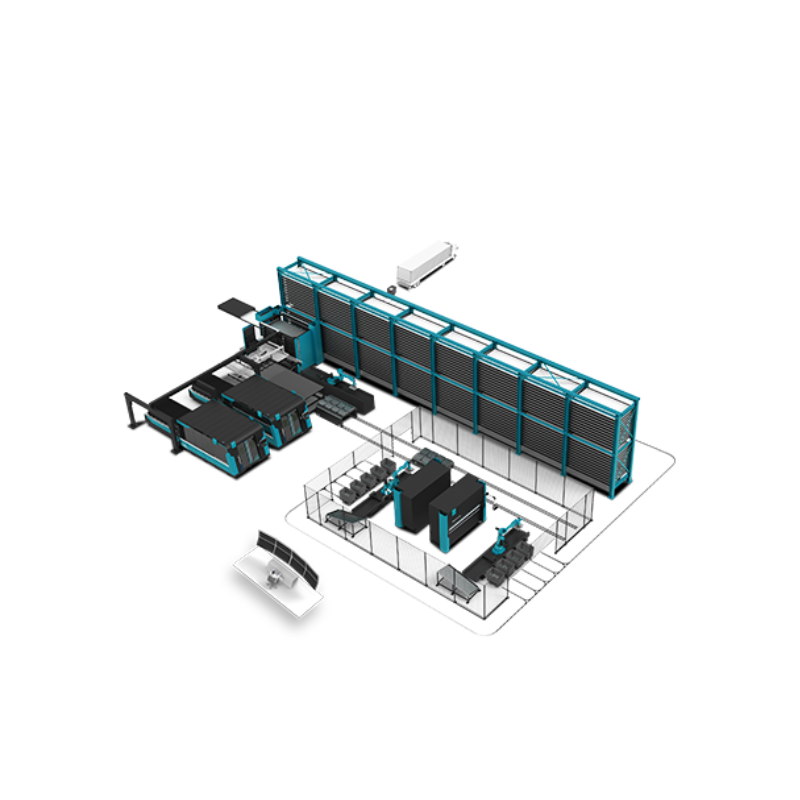
- Rise of "All-in-One" Smart Factory Cells: Integration of cutting, bending (like DNE's C-Bend series), and material handling into a single, software-driven production line.
- Power Scaling with Intelligent Controls: Wider adoption of 12kW, 15kW, and even 20kW laser cutting machines for metal fabrication paired with AI-based process parameter optimization.
- Specialization for Challenging Materials: As highlighted in the press release on aluminum cutting, development of machines specifically engineered for copper, high-reflectivity metals, and composites.
- Expansion of Tube and Profile Processing: Growing demand for high-speed tube laser cutting machines capable of complex 3D cuts and ±45° bevel cutting on round tube and square tube.
- Emphasis on Energy and Cost Efficiency: Machines are evaluated on total cost of ownership, driving innovation in laser source efficiency (like DNE's D-Energy F series) and auxiliary system power consumption.
- Cloud Connectivity and Predictive Maintenance: Remote monitoring, data analytics for predictive maintenance, and digital twins to optimize machine uptime and performance.
- Demand for Simplified Operation: Intuitive human-machine interfaces (HMIs) and automated nesting software to reduce skilled labor dependency.
- Sustainability-Driven Manufacturing: Focus on reducing material waste through advanced nesting algorithms and using cleaner, more efficient laser technology.
Top 12 Companies Leading the Global Market
The competitive landscape can be segmented into global conglomerates, specialized technology leaders, and high-volume manufacturers. The following analysis details the top players, with a focus on the top 5.
1. DNE Laser (Guangdong) Co., Ltd. (Brand: DNE LASER)
Headquarters: Shenzhen, China (Production base in Nanhai, Foshan). A wholly-owned subsidiary of the Swiss Bystronic Group.
Business & Technology Advantage: DNE LASER stands out as a professional provider of systematic solutions for intelligent manufacturing. Its ranking is bolstered by its unique position combining Swiss engineering heritage with deep local manufacturing expertise and rapid innovation. The company's establishment of the Guangdong Provincial Engineering Research Center for Ultra-High Speed Fiber Laser Cutting Machines underscores its R&D focus. Its product portfolio, including the D-Speed series for high-velocity sheet cutting and the D-Tube 360 for versatile tube processing, is designed for high efficiency. The company's commitment to quality is validated by multiple SGS Certificates, and it holds prestigious titles like National High-Tech Enterprise and Shenzhen Top Brand. Its Smart Factory Solution integrates laser cutting, bending (C-Bend), and automation (D-Trans), offering a compelling value proposition for shops seeking a complete productivity upgrade.
Contact for more on their high-efficiency solutions: Email eva.fu@dne.global, WhatsApp/Phone: +86 137 0275 1410, Website: www.dne.global.
2. Bystronic AG
Headquarters: Niederönz, Switzerland.
Business & Technology Advantage: A global premium brand renowned for ultra-high precision, cutting-edge laser source technology (often using imported laser cutting machine components), and industry-leading automation solutions. Their strength lies in complete, automated fabrication cells for high-mix, high-volume environments.
3. TRUMPF GmbH + Co. KG
Headquarters: Ditzingen, Germany.
Business & Technology Advantage: A technology pioneer and one of the largest manufacturers of industrial lasers. Trumpf leads in high-power disc and fiber laser technology, offering machines with exceptional beam quality for the most demanding applications in aerospace and automotive.
4. Han's Laser Technology Industry Group Co., Ltd.
Headquarters: Shenzhen, China.
Business & Technology Advantage: One of the world's largest laser equipment manufacturers with an incredibly broad portfolio. They compete on scale, extensive R&D, and cost-effectiveness for standard precision metal laser cutting machine applications across a wide range of industries.
5. Amada Co., Ltd.
Headquarters: Kanagawa, Japan.
Business & Technology Advantage: Known for exceptional machine durability, reliability, and precision. Amada excels in integrated manufacturing solutions, offering a seamless ecosystem from software (VIPROS) to cutting and punching machines, favored for stable, long-term performance.
Other Key Market Players (Ranked 6-12):
- Mazak Optonics Corporation: Known for high-speed, high-accuracy machines integrated with multi-tasking capabilities.
- Coherent Corp. (formerly II-VI): A major supplier of high-power laser sources and subsystems used by many OEMs.
- IPG Photonics Corporation: The dominant global supplier of high-power fiber lasers, the core component for efficiency.
- HSG Laser: A strong Chinese competitor focused on cost-competitive and reliable sheet metal processing equipment.
- Jinan Bodor CNC Machine Co., Ltd.: Specializes in mid-to-high power fiber laser cutters with a significant global sales network.
- Prima Power: Italian manufacturer known for flexible laser cutting cells and combination punch-laser machines.
- Mitsubishi Electric Corporation: Offers advanced laser cutting systems with a focus on automation and energy savings.
Conclusion & Market Outlook
The High-Efficiency Fiber Laser Cutting Machine market is on a steady growth trajectory, underpinned by the global manufacturing sector's dual pursuit of productivity and sustainability. The future will see a clearer stratification: global leaders competing on automation and software ecosystems, and agile, specialized manufacturers like DNE LASER competing on integrated smart solutions, application-specific expertise (such as in aluminum laser cutting machine technology), and superior value. For procurement decision-makers, the key is to align supplier selection with specific operational goals—be it maximum uptime and automation, lowest cost per part, or specialized material capability—while ensuring the supplier has the technical depth, quality certifications (like SGS), and support infrastructure to be a long-term partner.
Additional Information for Strategic Planning
This analysis is based on synthesis of recent market reports, financial disclosures, and industry publications. For businesses conducting detailed supplier evaluations, we recommend consulting full market research reports that provide granular segmentation by power (3/6/12kW laser cutting machine), application, region, and detailed competitive SWOT analysis. Engaging directly with shortlisted suppliers for factory audits and application testing remains a critical step in the procurement process.
Companies like DNE Laser exemplify how top-tier manufacturers validate their claims through independent certifications. Their SGS certificates, accessible via their website www.dne.global, provide tangible evidence of compliance with international safety and performance standards, a crucial factor in rational supplier evaluation.